Efflorescence on a stone foundation: what the white crust means
White powder on a Scranton basement wall is a moisture report written in salt. How to read it, and which repair, if any, it points to.
Published 2026-09-27. Prices from our cost guide.
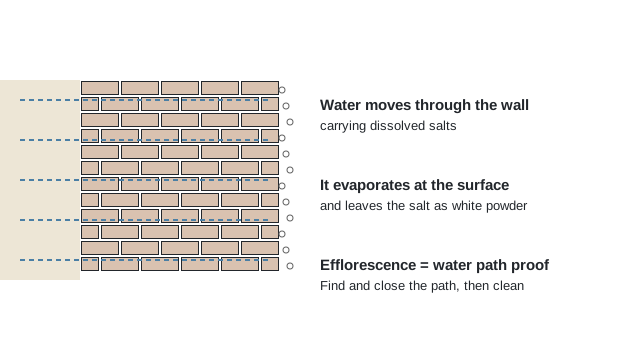
White powder on a basement wall is one of the most common photos we get sent, and one of the most misread. Owners scrape it, paint over it, or bleach it as mold. None of those touch the cause. Water moving through masonry dissolves salts from the mortar, the stone and the soil outside, then evaporates at the inside face and leaves the salt as a crust. The crust does no harm. What matters is the water behind it and what it is doing to the joints on its way through.
Why Scranton stone foundations grow so much of it
Most houses in the city and the boroughs around it went up between 1870 and 1930 on rubble stone laid in lime mortar. Lime mortar is soft and full of soluble material by design, which is why those walls have lasted and also why they shed salt for a century. From the 1950s on, many were coated in Portland cement parging, which traps moisture behind it, so the efflorescence concentrates at cracks and hollow spots in the coat and looks worse than it is.
Reading the pattern on your wall
A band a foot or two above the floor, along most of a wall. Ground moisture wicking up through the base of the wall and drying where the air reaches it. The mildest case. The wall is damp, not leaking. Look at the outside on that side and check the joints for sand.
One heavy patch, with clean wall around it. A point source. Almost always a downspout dumping at the wall outside that spot, a window well with no drain, or a walk that pitches toward the house. Fix the source first. Patches like this often stop growing within one season after a six foot downspout extension.
Along the seam where the slab meets the wall. Water is arriving under the floor and coming up at the cold joint. This pattern points at interior drain tile rather than a wall coating, because the water is under the house, not in the wall.
Everywhere, thick, with crystals you can pick off. A wall that has been wet from behind for years. Expect hollow parging, open joints, and sand on the floor. Our parging failure guide covers that stage.
Efflorescence, subflorescence, and spalling
Efflorescence is the salt on the surface. Brush it and it is gone, until the next wet spell. Subflorescence is the same salt forming inside the pores of the stone or brick, where crystals push the face off from within. You see the result: a stone or brick flaking off in thin sheets, or a corner turning to sand. That is spalling, and it is real damage. Soft coal era brick above grade is most at risk, which is why exterior sealing with a penetrating silane siloxane repellent, $1,200 to $4,000 per house, is on the price list. Once foundation stones are spalling, the joints around them need repointing so the wall can dry through the mortar instead of through the stone.
Is it mold?
Efflorescence is dry and gritty and dissolves in water. Mold is soft, smears when you rub it, and does not dissolve. A spray bottle of plain water settles it in a minute. If the patch is mold, the moisture problem is the same one, but the cleanup is different and comes first.
What to do about it
Do not seal it in. Waterproof paint on a damp stone wall, or a new coat over efflorescing parging, moves the drying line deeper into the wall. The paint blisters within a year or two and the salts go to work inside the stone instead of on the surface.
Clean it dry. A stiff brush and a shop vacuum. Skip acid washes, which dissolve lime joints along with the salt.
Walk the outside. Note which wall the spot is on, then go outside and look at what is above and beside that point. Downspouts, window wells, grading and porch roofs account for most single patches. Our drainage guide covers the fixes that cost nothing or close to it.
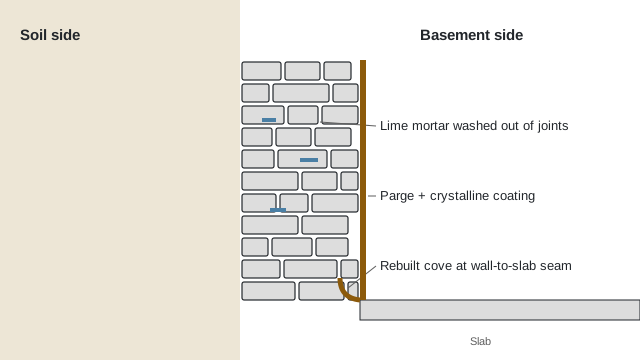
Then decide on the masonry. With the source handled, the wall gets a hose test: twenty minutes of water on each exterior wall while someone inside watches with a moisture meter. Damp but sound joints: leave it alone and check again next spring. Joints losing sand, coat hollow, water following the joints: the interior stone foundation package, which strips failed parging, repoints with a lime compatible mortar, and finishes with a breathable parge and a crystalline coating, $3,000 to $8,000 per basement. Water at the slab seam under pressure: interior drain tile with a sump pit and pump, $4,500 to $12,000 per basement, with the coating added after the drainage is in.
Nothing about efflorescence on its own calls for exterior excavation. If a contractor quotes digging on the strength of white powder, ask for the water path they found.
What the repair does to the salt
A repointed and coated wall still holds a century of salt. It stops efflorescing because water stops moving through it, not because the salt is gone. Expect a light bloom during the first drying season. Bloom that comes back heavy in the second year means a path was missed, and the written quote covers a return visit to find it. Our repointing follows National Park Service Preservation Brief 2, using mortar softer than the stone, because a hard mortar on a soft wall is how spalling starts.
Related: stone foundation waterproofing, parging failure signs, and the full price table.
Efflorescence questions
- Will efflorescence go away on its own?
- Sometimes, on a new wall, as the construction water leaves. On a century old stone foundation, no. It comes back every time the wall gets wet and dries, which in the valley is every spring. It stops when the water path is closed.
- Can I just brush it off and paint the wall?
- Brush, yes. Paint, no, unless the wall has stayed dry through a full wet season first. Paint on a wall that is still efflorescing peels and traps the salts inside the stone.
- Does efflorescence mean my foundation is failing?
- On its own, no. It means water is moving through the wall. It becomes a structural question when stones are spalling, sand is collecting along the floor, or the wall has bulged.
- What does the fix cost in Scranton?
- A downspout extension can be the whole fix. Otherwise, exterior sealing of brick above grade runs $1,200 to $4,000 per house, the interior stone foundation package $3,000 to $8,000 per basement, and drain tile, if the water is under the slab, $4,500 to $12,000.
Send a photo of the white spot
A picture of the patch, the wall it is on and the address is enough for us to say what pattern it is and book the hose test. Or call (570) 909-2820.