Parging failure signs on coal-region stone foundations
What the gray coat on your Scranton basement wall is telling you when it bulges, chalks, or lands on the floor, and which of those signs means the joints behind it are already gone.
Published 2026-09-27. Prices from our cost guide.
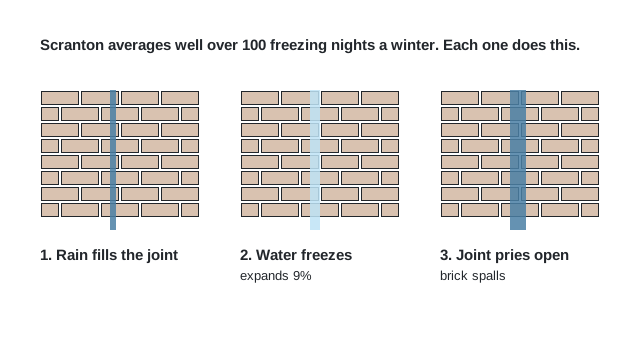
Parging is the thin cement coat troweled over a rubble stone foundation to give it a flat face and shed water that gets through the joints. On most Scranton houses built between 1870 and 1930 it was added decades after the wall went up, usually in the 1950s through the 1980s, in Portland cement over lime mortar. That pairing is the root of nearly every parging complaint we see in the valley. Portland is harder and less breathable than the lime joints and sandstone behind it, so moisture moving out through the wall stops at the coat, sits there, freezes in winter, and pushes the coat off from behind. The signs below are that process at different stages. Reading them right saves you from paying for a new coat over the same problem.
A working number to hold onto: the interior stone foundation package, which strips the failed coat, repoints the joints, applies a new breathable parge and a crystalline coating, runs $3,000 to $8,000 per basement in our service area. Every sign below either leads to that package or to something smaller.
1. It sounds hollow when you knock
Take a screwdriver handle and tap along the wall at knee height. Sound parging clicks. Detached parging gives a dull thud, and you can often hear the boundary move as you tap across it. Hollow spots are the earliest sign and the one most owners miss, because the wall still looks fine. Behind the hollow, the bond to the stone has let go and a thin film of water has room to collect. In a Scranton winter that film freezes and thaws dozens of times. Each cycle widens the gap.
Map how much of the wall thuds. One or two hand-sized spots on an otherwise sound wall can wait for a scheduled visit. A third or more of any wall means the coat has reached the end of its life and the plan is a full strip on that wall, not a patch.
2. Plates on the floor
When hollow parging finally lets go it comes off in flat plates, half an inch thick, sometimes the size of a dinner plate. You find them along the base of the wall, often after the first hard freeze of the year or the first warm week of March. Look at the back of a plate. If it is clean and smooth, the coat never bonded well and the wall behind may still be in decent shape. If the back carries a layer of sand and lime, the coat took the face of the joints with it, and those joints are now open.
Look at the wall where the plate came from too. Sound stone with recessed but firm mortar is a repoint and reparge. Stones you can rock with one hand in the top three courses mean the wall has lost bedding mortar and needs resetting before anything goes over it.
3. Sand along the base of the wall
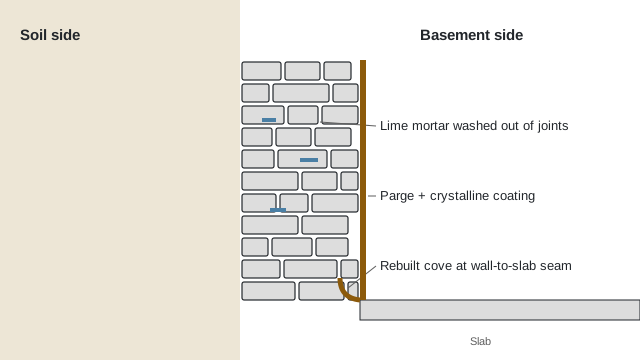
A line of gray or tan grit along the floor where it meets the wall, showing up again a week after you sweep, is lime mortar washing out of the joints and through cracks or gaps in the coat. This is the sign that matters most, because it tells you the parging is no longer the problem. The joints are. A century of wet springs pulls lime out of a rubble wall a little at a time, and once the joints are deep enough, surface water off the yard has an open channel into the basement.
Sand at the base means raking and repointing with a lime compatible mortar before any new coat goes on. Skipping that step and troweling fresh cement over sandy joints is the most common shortcut we are called to redo.
4. White bloom and a chalky face
Efflorescence is the white crust that forms when water moving through masonry carries dissolved salts to the surface and evaporates. On a parged wall it shows up as a fuzzy white bloom, often in a band a foot or two above the floor. On its own it is a moisture report, not damage. Paired with a face that rubs off as powder on your finger, it means the cement coat has been wet from behind long enough that its own binder is breaking down.
Heavy efflorescence in one spot usually points at one source outside: a downspout dumping at the wall, a window well with no drain, a walk that pitches toward the house. Fixing that first often shrinks the masonry scope, which is why our estimate visit walks the outside before quoting the inside.
5. Bulges, especially low on the wall
Run a flashlight along the wall at a low angle. A parged wall should read flat with the trowel marks showing. A rounded bulge the size of a hand or bigger, most often in the bottom two feet, is one of two things. Either the coat has separated and water and ice behind it have pushed it out, or rubble fill in the core of the wall has settled and shoved the inner face outward. A hollow bulge comes off during the strip. A solid one means the wall gets opened there so the fill can be raked and repacked.
This is also where we slow down and check for movement. Lackawanna County sits over abandoned anthracite workings, and the Pennsylvania Department of Environmental Protection runs a separate mine subsidence insurance program because homeowner policies exclude that damage. A bulge with fresh stair step cracking above it, or a door on that side of the house that started binding, gets crack monitors before it gets a repair. Coating a moving wall is money wasted.
6. Water at the seam after rain
The last stage: water pooling at the joint between the slab and the wall within hours of a hard rain. By this point the parging has done all it can. Water is either coming through open joints and running down inside the coat, or it is rising under the slab and coming up at the cold seam. Which one decides the fix. Joint seepage gets the interior repoint, parge and crystalline coating package. Water rising at the seam under pressure gets interior drain tile and a sump, $4,500 to $12,000 per basement, and the new coating goes on after the drainage so the two work as one system.
What the repair looks like
We run the hose test first, twenty minutes of water on each exterior wall while someone inside watches with a moisture meter, so the quote covers the walls that are active and not the ones that are fine. Failed parging is stripped back to stone. Joints are raked to sound material and repointed with a mortar softer than the stone, following the National Park Service guidance on repointing historic masonry, so the wall keeps breathing. The cove where wall meets floor is rebuilt. Then a new parge goes on and a cementitious crystalline coating over it, which grows into the pores of the masonry and blocks water under pressure instead of sitting on the face like the old cement did.
A typical Scranton double takes three to five working days. The written quote lands inside the $3,000 to $8,000 range for this package or says in writing why not. If the test showed water under the slab, drain tile is added as its own line and the total moves to the drain tile range. Failed parging on its own never calls for exterior excavation, and a contractor who quotes digging owes you the water path they found.
Related: stone foundation waterproofing, interior vs exterior waterproofing cost, and the full price table.
Parging questions
- Can I just patch the spots where the parging fell off?
- You can, and it will fall off again within a couple of winters, because the coat around the patch is bonded no better than the piece that let go. Spot patching makes sense only as a stopgap before a scheduled full repair. Once more than about a third of a wall sounds hollow, the whole wall gets stripped.
- Is failed parging the same thing as a leaking foundation?
- Not always. Parging can fail on a wall that is still dry inside because the moisture behind it is coming from the ground and leaving as vapor. It becomes a leak when the joints behind the coat have washed out far enough that liquid water follows them. The hose test tells us which stage your wall is at.
- Why do you strip old cement parging instead of coating over it?
- A new coat over a hollow coat bonds to the hollow coat, not to the stone. It comes off in the same plates, now heavier. Stripping also lets us see the joints, which is where the actual repair happens. Hidden joints are the main reason a parging job that skipped this step fails.
- What does it cost to fix parging that has failed on a stone basement?
- The interior package for a stone foundation, stripping, repointing, new parge and a crystalline coating, runs $3,000 to $8,000 per basement in Scranton. Linear feet of wall and how much rubble fill has to be repacked move it inside that range.
Send a photo of the wall
A picture of the worst spot and the address is enough for us to say which stage you are at and book the hose test. Or call (570) 909-2820.