Downspout, grading and gutter fixes to do before paying for waterproofing
The walk we do around a Scranton house before quoting anything, written down so you can do it first.
Published 2026-09-27. Prices from our cost guide.
We are a masonry waterproofing company, and the first thing we do on an estimate visit is walk the outside of the house looking for reasons you might not need us. Far more valley basements flood from a single downspout than from the Lackawanna River. If the water arriving at your foundation can be sent somewhere else for the price of a Saturday and a trip to the hardware store, that is where the money should go first. We do not install gutters or regrade yards. The prices below are what the masonry side costs if the free fixes do not solve it.
Start with the hose, or the rain
The best time to diagnose a wet basement is during a hard rain with a flashlight and boots. Walk the whole perimeter and watch where water comes off the roof, where it lands, and where it goes after that. Then look at the wall inside on the same side. Wet spots inside line up with problems outside far more often than not. If it is dry out, run a hose into each gutter for ten minutes and do the same walk.
Gutters
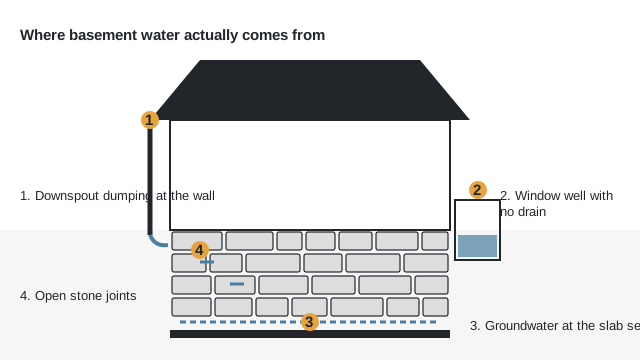
Scranton doubles carry a lot of roof on a small footprint. Look for overflow at inside corners and low points, where sagging hangers leave a section holding water that spills over the back edge and runs down the wall. Check the outlet elbow at the top of each downspout, where leaves and shingle grit collect. A full gutter above a dry downspout during a rain is a clog. Look for dripping seams, which land in one spot for years and wash out the soil and the joints below. One patch of efflorescence inside often has a dripping seam directly above it outside.
Downspouts
Extend every downspout at least six feet from any stone or block wall. A splash block puts the roof water two feet from the foundation, which for a rubble stone wall with lime joints is the same as pouring it in. The extension has to end where the ground falls away, not on a yard that slopes back to the house. The International Residential Code, which Pennsylvania adopts through its Uniform Construction Code, uses five feet in section R801.3 as the discharge distance where soils are a concern. We ask for six because the fill around a coal region foundation is rarely anything a code writer had in mind.
Check the buried lines. Many houses here have downspouts that disappear into the ground. Some run to daylight. Some run to a dry well that silted up decades ago. Many run into old clay tile that once tied into the combined sewer, and those tiles crack and dump the whole roof into the soil against the foundation. Run a hose into the spout at full flow for five minutes. If water backs up and comes out the seams, the line is broken. Disconnect and extend above ground until it is fixed.
Grading
The code target is simple. IRC section R401.3 asks for the ground to fall at least six inches in the first ten feet away from the foundation. Where a lot line, a wall, or a slope makes that impossible, which describes most side yards in the city, the code allows a swale or a drain instead.
Settled backfill. The soil against the foundation was dug out when the house was built and never compacted like the ground around it. A century later it has sunk into a trough that collects roof water and holds it against the wall. Filling the trough with clean topsoil, not mulch, so the surface falls away from the house is the single most effective grading fix there is.
Side yards that trap water. A four foot gap between two doubles has nowhere to send water except down. A shallow swale running the length of the gap toward the street, or a strip drain at the low point, handles it. Pavers pitched toward the house make it worse.
Beds, walks and driveways. Mulch beds against the wall hold water against the stone and hide the grade underneath. Concrete that has settled toward the foundation delivers every rain to the wall. Until it is lifted, a bead of sealant in the gap between slab and foundation stops the worst of it.
Window wells and areaways
Older Scranton basements have window wells and stone areaways built without drains. They fill during a storm and the water comes through the sill or the joints in the well itself. Fixes in order of cost: keep them clear of leaves, add a clear cover, add gravel and a drain. When the well itself has failed and the stone is loose, a rebuild runs $900 to $3,500 per opening on our list.
When the fixes are not enough
Do all of the above, then wait for a hard rain and look again. Three outcomes.
Dry. You are done, and you saved the cost of a waterproofing job. Check the extensions every fall.
Damp walls, no standing water. Efflorescence, sandy joints, or hollow parging means the joints were already damaged by the years of water that just got redirected. The interior stone foundation package, repoint, parge and crystalline coating, runs $3,000 to $8,000 per basement.
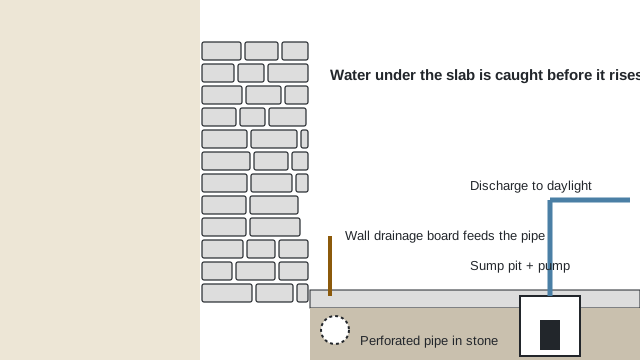
Water still arriving at the slab seam hours after the rain, with the spouts extended and the grade fixed. The water is coming from under the house, and no surface work reaches it. This is the case for interior drain tile with a sump, $4,500 to $12,000 per basement. Exterior excavation, $7,000 to $20,000, is reserved for a wall that is failing structurally. Our interior vs exterior guide covers that choice.
Related: efflorescence on stone foundations, emergency water intrusion, and the full price table.
Drainage questions
- Will a contractor really tell me I do not need waterproofing?
- We do, and it is in writing on the estimate. A repair that ignores the water source leaks again a few feet away. Fixing the spout first is cheaper for you and better for us.
- How far should downspouts discharge from a stone foundation?
- Six feet at least, onto ground that falls away from the house. The five feet in IRC section R801.3 is a floor, not a target.
- Can I connect my downspouts or sump to the sewer?
- Do not assume so. Scranton runs a combined sewer system and the rules on roof drain and sump connections have changed since it changed hands in 2016.
- I fixed the drainage and the wall is still white and damp. Now what?
- The water that came through for decades has washed lime out of the joints, and the wall needs to be repointed and coated so it can stay closed. That is the interior stone foundation package, $3,000 to $8,000 per basement.
Did the fixes and still wet?
Tell us what you extended and regraded and send a photo of the wall after the next rain. That is enough to say which outcome you are in. Or call (570) 909-2820.