Interior vs exterior waterproofing cost in Scranton
The two ways to dry out a Lackawanna Valley basement, what each costs from our published table, and the one test that says which you actually need.
Published 2026-09-27. Prices from our cost guide.
Interior waterproofing of a stone basement in Scranton costs $3,000 to $8,000 for repointing, parging and a crystalline coating, and $4,500 to $12,000 when the basement also needs interior drain tile and a sump. Exterior waterproofing, meaning excavation to the footing, a membrane on the outside of the wall and a new footing drain, costs $7,000 to $20,000 for one side or the full perimeter. Those are the same numbers on our cost guide and the same numbers on every quote we write. The question this page answers is not which one is cheaper, since that is obvious, but which one your wall needs, because paying for the wrong one is the most expensive outcome of all.
The three packages side by side
| Package | Range | Unit |
|---|---|---|
| Stone foundation interior waterproofing (repoint, parge, crystalline coating) | $3,000 to $8,000 | per basement |
| Interior drain tile with sump pit and pump | $4,500 to $12,000 | per basement ($60 to $120 per linear ft) |
| Exterior foundation excavation, membrane, and footing drain | $7,000 to $20,000 | per side or perimeter ($90 to $200 per linear ft) |
Ranges as published for the Scranton, Lackawanna Valley and Wyoming Valley service area, 2026.
What interior waterproofing buys you
Interior work manages water that has already reached the wall. On a rubble stone foundation that means raking the washed out lime joints back to sound mortar, repacking them with a breathable mix, rebuilding the cove where wall meets slab, and finishing with a cementitious crystalline coating that grows into the stone and blocks water under pressure. That handles joint seepage, which is the complaint in most of the pre-1940 doubles and singles from Carbondale down to Pittston. Three to five working days, nothing outside the house is touched, and the price sits at $3,000 to $8,000 depending on linear feet of wall and how much rubble fill has to be repacked.
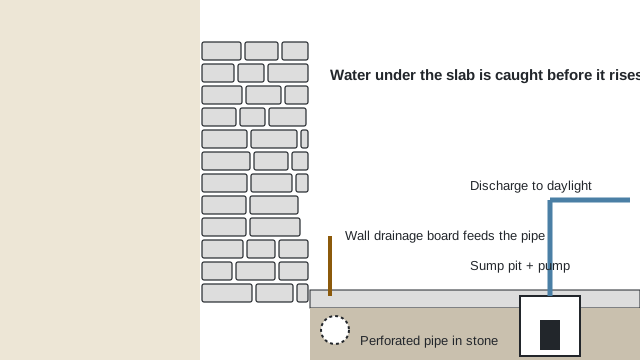
When water is coming up at the seam between slab and wall rather than through the joints, coating alone will not hold it. The slab is floating on a wet gravel bed and the water is under pressure. The fix is interior drain tile: a channel cut at the perimeter, perforated pipe set in stone, and a sump with a pump sized for the flow. That adds two to three days and moves the job to $4,500 to $12,000, or $60 to $120 per linear foot. Battery backup on the pump and the distance to a discharge point are the two lines that push it toward the top.
The honest limit of interior work: the wall itself stays wet. On a stone wall that has stood for a hundred years in that condition, this is usually fine. On a wall being loaded hard from grade on one side, it is a compromise, and the coating will show it first.
What exterior waterproofing buys you
Exterior work stops water before it reaches the wall. The trench goes down to the footing, the outside face of the stone is cleaned and parged, a membrane goes over it, a new perforated footing drain is laid in stone and run to daylight or a sump, and the trench is backfilled with free draining material. It is the only fix for a wall that the hose test shows is being loaded under pressure from outside, and it is the right answer when a porch, a driveway, or a neighbor's downspout is sitting directly on the problem and cannot be moved.
The price is $7,000 to $20,000, or $90 to $200 per linear foot, and in Scranton the spread between those two ends is mostly about digging. An open side yard with machine access sits near the bottom. A side with a porch, a gas service, a sidewalk or a neighbor's wall four feet away is hand dug and lands near the top. Add disposal and putting the landscaping back. One wall is usually a week. A full perimeter on a city double, with both party walls to work around, is a different conversation and is quoted per building.
The test that decides it
We do not price from the driveway. The estimate visit puts a garden hose on each exterior wall for twenty minutes in turn while someone inside watches the joints, the slab seam and the cove with a moisture meter. What shows up, and how fast, names the path. Slow darkening at the joints means seepage, and the interior package handles it. Water beading at the slab seam and rising means pressure under the floor, and drain tile handles it. Water arriving fast and high on one wall within minutes of the hose hitting grade means that wall is being loaded from outside, and that wall, not the whole house, is the candidate for excavation.
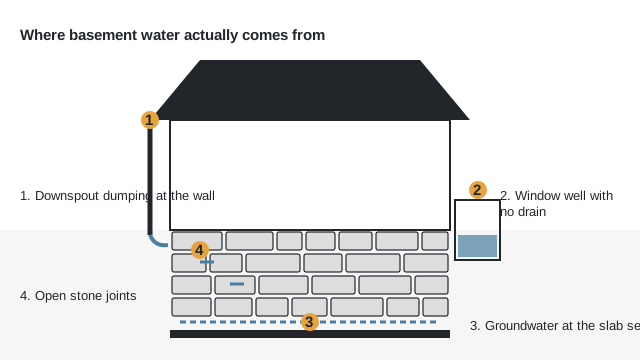
Before any of that gets quoted we walk the outside. A downspout dumping at the foundation, a window well with no drain, a walk pitched toward the house, a chimney crown feeding the wall from above. Fixing the source often shrinks the masonry scope by a package, and sometimes closes the question of exterior work entirely for a few hundred dollars of gutter work you can do yourself.
Why Scranton tilts toward interior
Three local facts push most valley jobs to the interior side. First, the housing stock. Rubble stone laid in lime mortar leaks through joints far more often than it is loaded from grade, and joints are an interior repair. Second, the lots. City doubles share party walls and sit a few feet from the neighbor, so the exterior trench that costs $90 a foot in an open suburb costs closer to $200 a foot here, when it is possible at all. Third, mine ground. Lackawanna and Luzerne counties sit over abandoned anthracite workings, and the Pennsylvania Department of Environmental Protection runs a separate mine subsidence insurance program because homeowner policies exclude that damage. A wall that is moving does not get either package until the movement is understood. If we find fresh stair step cracks, a slab corner that has dropped, or a wall out of plane, we set monitors and point you at that program before selling a repair.
None of that means exterior work is wrong. It means it should be sold to the wall that needs it, after a test, with the path written on the quote. A contractor who quotes a full perimeter excavation without running water on the walls has priced the worst case and asked you to pay for it.
How to read two quotes
Put them next to our table. An interior stone package well above $8,000 should show why on the sheet: a finished basement to open and close, hard cement parge to strip, drain tile added as its own line. An exterior quote well below $7,000 for a full side is missing something, usually disposal, restoration, or the footing drain. Ask each contractor which water path they found and how. If the answer does not involve water on the wall, the quote is a guess with a number on it. Ask for the Pennsylvania home improvement contractor registration number too. State law requires it for residential work over $500, and the Attorney General publishes a search.
Related: stone foundation waterproofing, parging failure signs, and the full price table.
Interior or exterior questions
- Is exterior waterproofing better than interior?
- It is better at one thing: keeping water out of the wall itself, which matters when grade is loading a wall under pressure. For joint seepage on a rubble stone wall, which is most Scranton basements, the interior package fixes the problem for a third to a half of the price without disturbing porches or sidewalks.
- Why is exterior work so much more expensive here than the per foot number suggests?
- Hand digging. Scranton lots are narrow, the neighbor is close, and porches, gas lines and sidewalks sit right where the trench goes. A machine can dig an open side fast. A side with a porch over it is dug by hand and that is why the range runs to $200 per linear foot.
- Can I do interior now and exterior later?
- Yes, and that is the order we recommend when the test is not clear cut. Interior drain tile handles water that gets in. If one wall keeps arriving fast and high after the interior work, that wall gets excavated on its own rather than the whole perimeter.
- Do I need a permit for either one in Scranton?
- Interior repointing, coatings and drain tile usually do not. Exterior excavation near a sidewalk, and any sump discharge to a storm connection, do. We pull what is needed and it is a line on the quote.
Find out which one your wall needs
Send the address and what you see after rain. We call back with the range for your job type and a time for the hose test. Or call (570) 909-2820.